
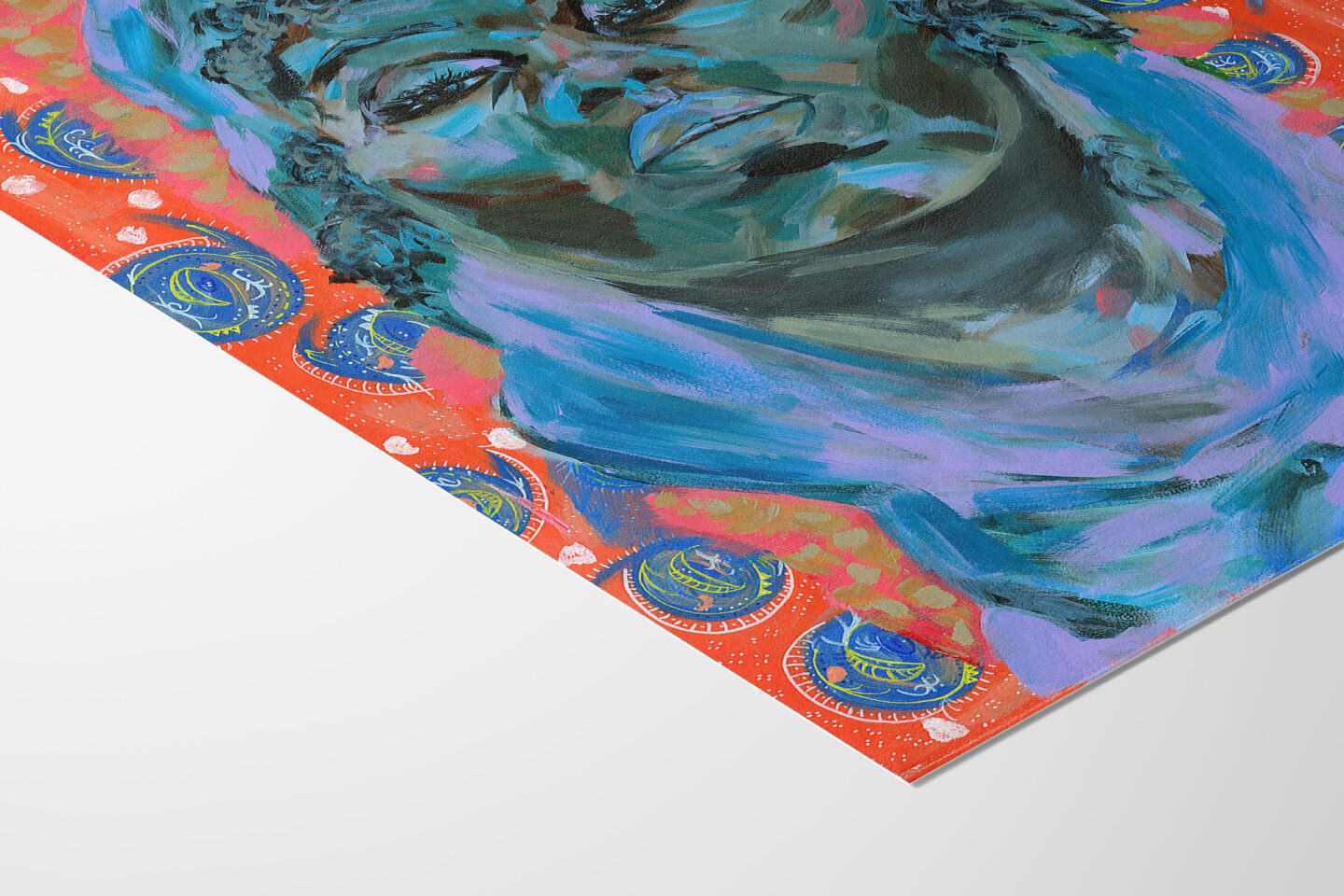
Contemporary Art and the Privilege of Seeing From More Than One Angle
The privilege of seeing from different angles is not a small artistic advantage. For many artists from the Afro diaspora, the Afro-Caribbean diaspora, Asian diaspora, and wider non-white communities, it is a form of knowledge. Not knowledge learned from distance, but knowledge formed through movement, translation, observation, adaptation, exclusion, inheritance, and return. It is the ability to see the room and the door. The center and the margin. The invitation and the condition attached to it.
This is where contemporary art becomes confrontational without raising its voice. A painting, sculpture, or illustration does not need to explain everything. It places another way of seeing in front of the viewer and asks whether the viewer has the courage to meet it without reducing it.
Afro diaspora and Afro-Caribbean diaspora art and the discomfort of recognition
There is a difference between looking at art and being asked to shift position because of it. That shift is often where discomfort enters.
Afro diaspora and Afro-Caribbean diaspora carries histories that are not decorative. It holds migration, colonial memory, language, rhythm, religion, silence, family structures, social identity, and the pressure of being seen through someone else’s system before being understood on one’s own terms. When that enters the art market, the question becomes more complicated than taste.
People often speak about inclusion as though recognition arrives through goodwill alone. Yet the art world has always been tied to infrastructure. Galleries, fairs, museums, advisors, curators, critics, insurers, auction houses, and private rooms all shape what receives attention and what stays obscure. The work does not travel by beauty alone.
The Art Basel and UBS Art Market Report has repeatedly shown how wealth, access, and buying power concentrate at the upper end of the market. That matters because the language around value is rarely neutral. When a work by a non-white artist enters a high-price tier, the conversation often changes. The message that once felt too direct becomes collectible. The discomfort becomes cultural capital. The challenge becomes an asset.
That shift deserves attention.
When black art becomes an asset before it is understood
There is an uncomfortable question sitting beneath many conversations about black art, African art, and contemporary art from diasporic communities. Why does the allowance for a message change once the work is protected by price?
Before recognition, the artist is often asked to be legible, grateful, available, and explainable. After recognition, the same artist is called visionary. The same themes become significant. The same confrontations become necessary. The same cultural development that once lived outside the room is later framed, insured, shipped, catalogued, and placed under controlled lighting.
This does not erase the achievement of the artist. It exposes the conditions around the achievement.
The artist from a marginalized group has often been working long before the market arrives. The practice existed before the applause. The visual language existed before the acquisition. The cultural growth existed before the invitation. What changes is not always the work. Often, what changes is who gains permission to recognize it publicly.
That is where money enters with a quiet force. Art collecting is never only about possession. It is also about belief, risk, access, taste, legacy, and the desire to stand close to meaning while still keeping one’s position intact. Large paintings, intimate works, sculptures, drawings, and installations all pass through this tension once they enter systems of value.
The question is not whether money belongs in art. Money has always been there. The sharper question is what money asks art to become once it arrives.
The superpower of the non-conventional position
Artists from the Afro diaspora and Afro-Caribbean diaspora often do not begin from the fantasy of neutrality. That is part of the strength. The work does not need to conform to a single inherited viewpoint. It speaks through crossings, contradictions, layered memory, and the knowledge that identity is not flat.
This is not about making art more political for the sake of relevance. It is about understanding that social identity already lives inside the visual field. Color, scale, gesture, material, repetition, absence, figuration, abstraction, and composition all carry decisions. The artist’s position becomes part of the intelligence of the work.
The Burns Halperin Report on equity and representation in United States museums and the art market has documented how women and artists of color remain underrepresented across major institutional and market structures. That absence is not an abstract number. It affects what is preserved, taught, collected, remembered, and treated as serious.
So when an artist from a non-white background offers an alternative position, the work is not asking for charity. It is offering a fuller account of the human condition. It gives the viewer an opportunity to step outside inherited certainty. That opportunity is rare, and it is often resisted.
Art galleries, decolonization, and the price of being seen
The conversation around decolonization in art is often made too clean. The word appears in panels, exhibition texts, public statements, and institutional language. Yet the deeper question remains less comfortable. Who has to become valuable before their perspective is treated as necessary?
Art galleries have a role in this question. So do the people who enter them. So do those who buy quietly, follow artists over time, ask better questions, and learn to stay with work that does not flatter them. The infrastructure behind art collecting is not only financial. It is emotional, cultural, intellectual, and moral.
To support black women in contemporary art, to engage seriously with Afro-Caribbean diaspora practices, to make space for African art beyond trend, means moving past the desire for a clean story. It means accepting that some works do not exist to soothe the room. Some works ask the room to reveal itself.
That is not a problem. That is the point.
The unresolved question inside the art collection
Every art collection tells a story, even when no one names it. It tells what someone chose to live with. It tells what someone believed would matter later. It tells which voices were allowed to occupy space, which histories were treated as worthy, which risks were taken, and which discomforts were avoided.
The privilege of seeing from more than one angle is not only the artist’s superpower. It becomes an invitation to the viewer as well. The work stands there, holding more than one history, more than one geography, more than one wound, more than one form of beauty.
The question that remains is simple, and not simple at all.
When art asks for vulnerability instead of agreement, who is willing to stay in front of it long enough to be changed?
Want to read more? Subscribe to my social media platform and join to be one of the few to see my exclusive posts on this website.
Sources
Art Basel and UBS, The Art Market Report 2024, written by Dr. Clare McAndrew, Arts Economics.
The Burns Halperin Report, Equity and Representation in the Art World, 2022.

Find me on: Web
